Saturday, April 20, 2013
Susan Hauptman
A ghostly black-and-white visage gazes solemnly out of Susan Hauptman’s life-size photorealistic self-portraits. Assuming various ambiguously gendered identities—dressed in clownish garb, a negligee, or conventional dress, and usually sporting a buzz-cut—Hauptmann subverts traditional representations of the female form, at once embodying and undermining gender stereotypes. Absurdist motifs and objects recur in Hauptman’s work, sometimes assuming symbolic value: a vase or a birthday cake, her dog or the face of her husband. In its more androgynous, sexualized iterations, Hauptman’s self-portraiture has drawn comparisons with Otto Dix’s depictions of prostitutes.
Monday, April 15, 2013
Felideus
Spanish artist Felideus has worked as an art director, graphic designer, animator and screenwriter in audiovisual productions. He currently works as a freelance illustrator, designer and writer.
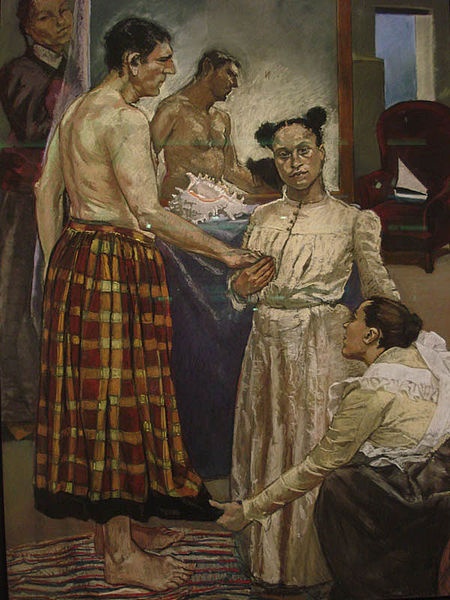
Paula Rego
Paula Rego was born in Lisbon, Portugal in 1935 and has traveled between London and Portugal throughout her life. She studied painting at the Slade School of Fine Art, London, and her career as an artist spans half a century.
Working from literature, myths, fairy tales, cartoons and religious texts, Rego creates narrative works imbued with mystery. She is drawn to subjects that are well known and well resolved, and takes her imagery from sources as varied as Peter Pan and Mary Magdalene.Rego currently lives and works in London, and is considered one of the leading figurative artists of the day.
In her own words...
"I came to England in 1951 when I was 16 to go to art school. I had been interested in art since I was four. But first my parents sent me to a finishing school in Kent. There I had a teacher called Mr Bradshaw who helped me to get a place at Chelsea School of Art. My parents were not pleased because a friend of theirs had gone to Chelsea and came away pregnant. They thought that could happen to me and said I had to look for a better school, and that the Slade was the best of alI. I got an interview and studied there part time, but I don’t think the tutors really liked what I painted – I have always painted figurative works. I remember the abstract artist Victor Pasmore gave me a tutorial and when he saw my pictures he said, 'What is this, it is a load of rubbish – you should be painting abstract pictures, like I do.’ I told him I didn’t know how to do that and he had to accept it."
Sunday, April 14, 2013
The Nazi Drawings
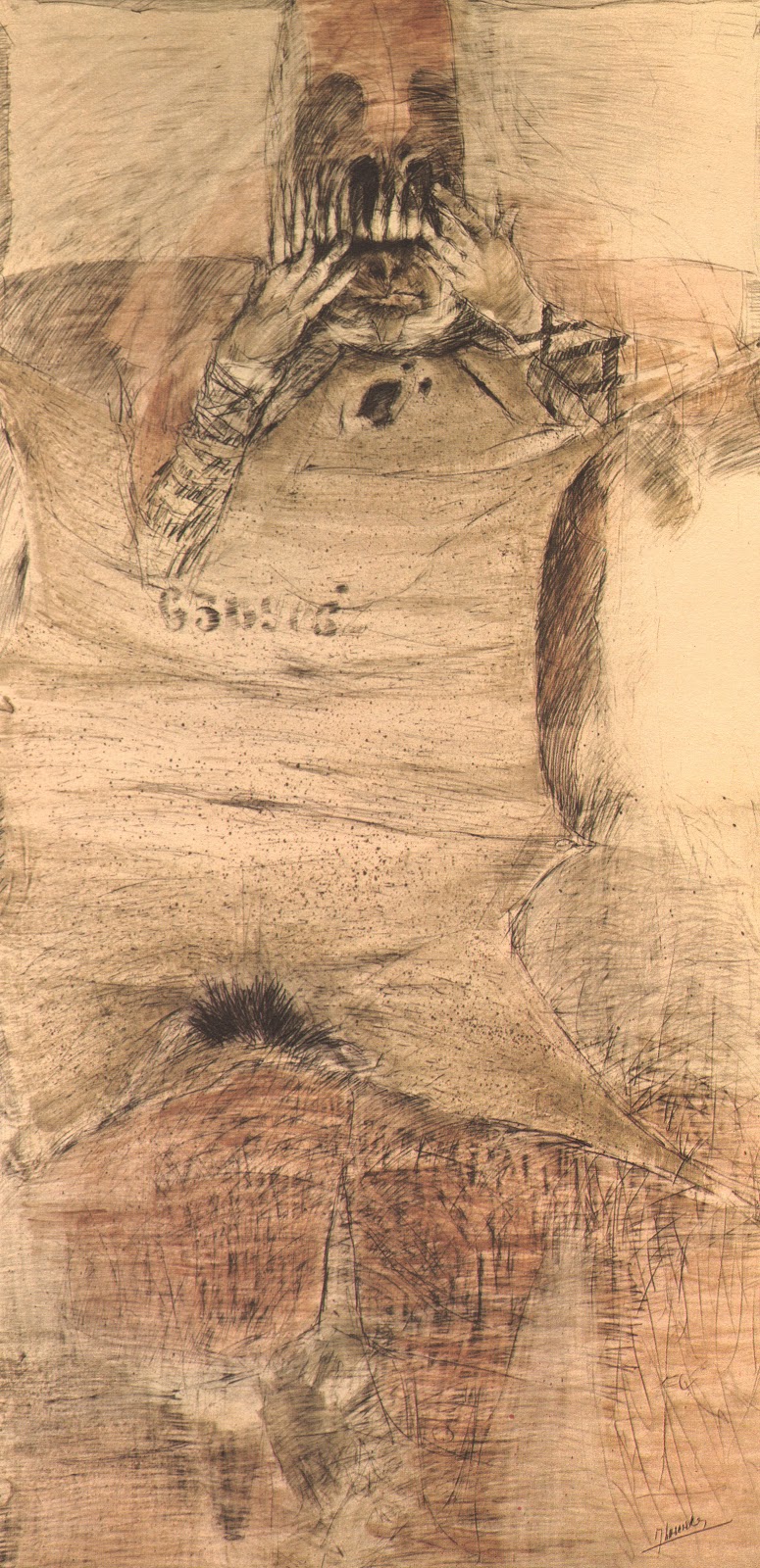
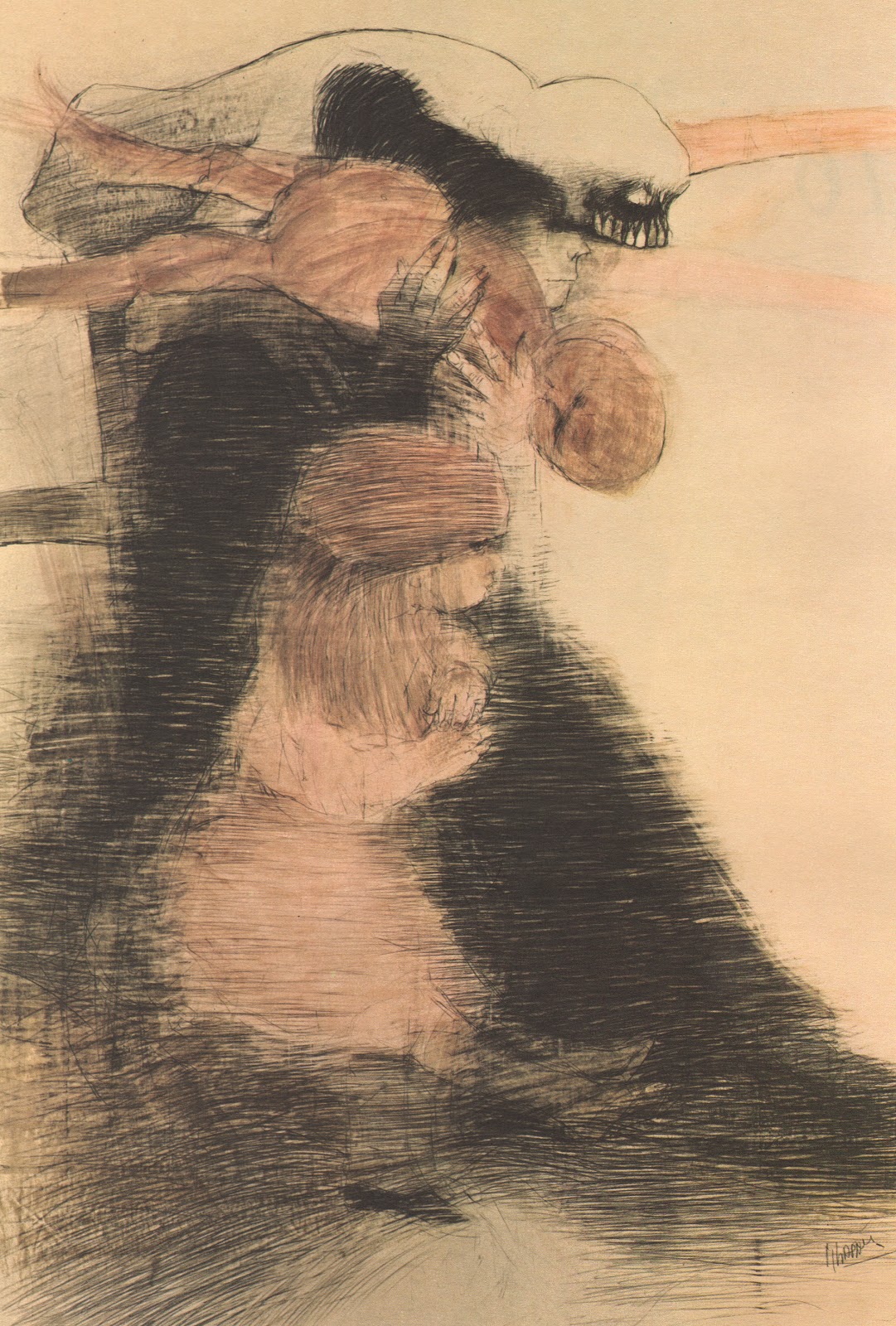
The following series of drawings was created over a five year period and completed in 1966 by Mauricio Lasansky. Lasansky was born in Argentina in 1914 and became a resident of the United States in 1943. He was a professor at the University of Iowa, in charge of the printmaking department and a Guggenheim Fellow. As teacher and practitioner of the art of the print, his work was known and admired throughout the civilized world.
The Nazi Drawings were created as a reaction to the horrors imposed by the Nazi regime against humanity. They were created in plain paper and ordinary pencil — the most humble, universal materials possible, he explained. Made over a six-year period and completed in the mid-1960s, it spans 33 images, tinted with washes of brown and rust. The drawings are large, ranging from roughly 40 inches to over 70 inches in height.
Mauricio Lasansky passed away a year ago, in April, 2012 at age 97. A great loss to the art world.
Of his Nazi Drawings, Lasansky says the following:
The Nazi Drawings were created as a reaction to the horrors imposed by the Nazi regime against humanity. They were created in plain paper and ordinary pencil — the most humble, universal materials possible, he explained. Made over a six-year period and completed in the mid-1960s, it spans 33 images, tinted with washes of brown and rust. The drawings are large, ranging from roughly 40 inches to over 70 inches in height.
Mauricio Lasansky passed away a year ago, in April, 2012 at age 97. A great loss to the art world.
Of his Nazi Drawings, Lasansky says the following:
"Dignity is not a symbol bestowed on man, nor does the word itself possess force. Man's dignity is a force and the only modus vivendi by which man and his history survive. When mid-twentieth century Germany did not let man live and die with his right, man became an animal. No matter how technologically advanced or sophisticated, when a man negates this divine right he not only becomes self-destructive, but castrates his history and poisons our future. This is what The Nazi Drawings are about."
Friday, April 12, 2013
Isidro Ferrer
Isidro Ferrer (Madrid, 1963) is a Spanish illustrator and graphic designer trained in drama. He was a stage actor before guiding his career toward illustration and graphic design.
His images play with different meanings. Everyday objects take on a unique significance, often used as a means to represent himself.
Subscribe to:
Posts (Atom)


.jpg)